Posts

Napier

Image
The town of Napier is on the east coast of New Zealand's north island. It is famous for art deco architecture. An earthquake and susequent fire in 1931 killed 256 people and injured hundreds more. It is regarded as New Zealand's worst natual disaster. The town was rebuilt in art deco style which is a key tourist attraction. There are several vintage cars around the town. Some of these take passengers on a guided tour of the buildings, raising money to help preserve the cars.

Drive Rotorua to Napier

Image
We read another blog describing the drive from Rotorua to Napier and explored the suggested diversions. The bridal veil Waipunga Falls were simply signposted "Scenic View" and might have been missed, while Huka Falls were named. The scenery from Taupo to Napier varied from mountain forest to cleared hills. A lot of timber is being "harvested" given the number of trucks on the road hauling logs. Our room in the Nautilus Hotel has a view of the Pacific Ocean through the pine trees. The unexpected bonus is a large spa bath, small kitchen, and separate bedroom. The "beach" consists of smooth stones, decreasing in size towards the water's edge to coarse sand. This is not a swimming beach, not that I would be tempted with the temperature having dropped to 15°.

Orakei Korako Thermal Park

Image
This thermal park has wonderful scenery. An amazing 20 million litres of boiling water water trickle or gush from underground ending up in the lake. At the edge of the lake the water was so clear we could see fish and eels. Unfortunately the fish were koi carp which are as much a pest here as they are at home. A quirky item in the park's shop was a stuffed kiwi. We are unlikely to see a live one so here it is.

Geothermal Rotorua

Image
Our day started with a walk to the Ciabatta Bakery in an industrial area 1km from our hotel. Great coffee and food if careful what you order. We then walked along the lake front and explored the geothermal areas beside the lake and in Kuirau Park. There are about 60 different bird species around the lake. While there is an old tyre in the photo near the swan, generally NZ has much less litter than Oz. In Kuirau Park the hot pools are fenced, but at Sulphur Bay at the southern end of the lake many are unfenced. After lunch at the Fat Dog Cafe we drove 30 minutes to the Waimangu Volcanic Valley. This is the only hydrothermal system in the world that can be exactly dated. On 10 June 1886 a violent volcanic eruption of Mount Tarawera caused the formation of a series of craters and allowed the geothermal waters to surface. About 150 people were killed and volcanic ash and debris completely tranformed the landscape. Our favourite site in the valley was the blue inferno crater. ...

Rotorua

Image
This is the i-site building where we picked up a local map and a few brochures to plan how to get into hot water. The tudor style building used to be the post office, but has since been gutted internally and (hopefully) been made safe for earthquakes. We are staying at the Rydges Rotorua with bus loads of Indian and Chinese tourists. It is a bit dated but we have a large clean room with a view of green hills. New Zealand doesn't have the same safety focus as Australian regulators. The hot water in hotels could scald the unwarry; there are no crash barriers on windy roads with scary long drops over the edge; and most surprising is our fourth floor window opens far enough for kids and adults to jump or fall out.

Cathedral Cove

Image
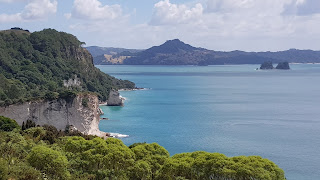
Today we drove 75kms to Hahei to walk to Cathedral Cove. We stopped at the town of Tairua located on a protected inlet on the east coast of the peninsula. A jet ski race was in progress so we opted for a quiet cafe. There is a car park just outside Hahei where we caught a shuttle bus to the beginning of the walk at a cost of $5 each return. We were lucky to see some sun but also had cloud while walking up steep hills and steps. The Cove has a large gothic shaped arch and a lovely beach. It's possible to snorkel in these waters but we saved that for another visit. On our way home we stopped at Hot Water Beach. Two thermal springs under the sand are accessible 2 hours either side of low tide. People dig holes in the sand and mix cold ocean water with the spring water which can be as hot as 64°C so needs to be cooled. A nice clean bathtub is more attractive to me, instead of sharing a hole dug in the sand with others.

Walk Around Thames

Image
Yesterday I walked about 5kms around Thames. The tide was out and I discovered the gluggy mudflat. This is certainly not a swimming or boating beach. A wharf was built in the 1920s but it's use was limited as the harbour silted up. All the tall trees in the area were logged so erosion probably contributed to the silt. My favourite building is the Workingmens Club because of its architecture. The sunset from our chalet was impressive.